For instructors and training programs
Your system knows who finished.
It cannot tell you who is ready.
Cohort readiness, per topic and per student, with every question traced to its FAA source.
The gap
You already have this
Attendance, completion, credential attainment — whatever your workforce or compliance reporting requires. It is a solved problem and we are not selling it to you twice.
No record system has this
Which student should not book the exam yet. Which topic the class is weakest on this week. Whether what you are teaching matches the test as it is weighted today.
Those are different questions from “who finished,” and they need a different instrument.
What changed under everyone
The FAA retired the ACS testing blueprint for this exam on 29 September 2025 and moved the weighting to PSI’s Applicant Information Bulletin. FAA-S-ACS-10B is still posted and still reads April 2021.
Regulations moved from a fifteen-to-twenty-five percent band to 48% of the exam. The full weighting, and the sentence from the bulletin it came from, is on the exam guide.
| Area | Code | Share of the exam |
|---|---|---|
| Regulations | UA.I | 48% |
| Airspace Classification and Operating Requirements | UA.II | 20% |
| Weather | UA.III | 5% |
| Loading and Performance | UA.IV | 2% |
| Operations | UA.V | 25% |
The instrument
Cohort readiness
By student and by topic, with the sample size beside every score. A topic with fewer than 5 answers is greyed rather than scored — too thin to judge, and we say so instead of showing a number we cannot support.
Reteach first
The view names the topic to reteach, from the class rather than from a hunch. It counts only students with a real sample, and below three of them it says so rather than calling one student's bad week a class trend.
Timed exams that match the sitting
The real sitting is 65 questions in 120 minutes — 60 scored and 5 unscored validation items nobody identifies for you. Our sim runs the 60 scored questions against the same clock, weighted to the live blueprint. 5 consecutive sims with no repeated question, for any account.
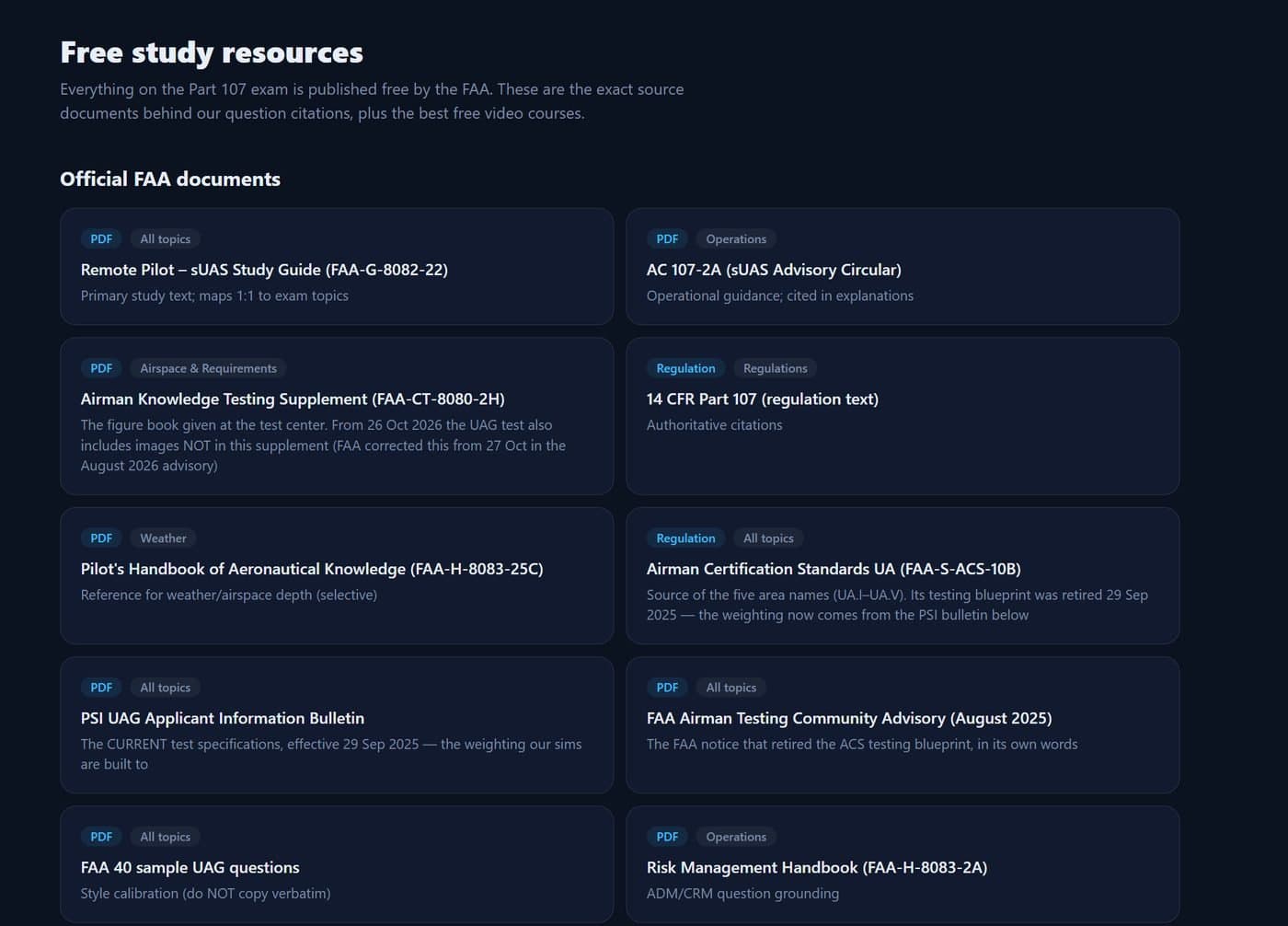
Every answer has a source you can read. Each of the 464 questions names the FAA document its answer comes from. Where it cites a regulation, Read the source under the explanation shows the section text with its as-of date; where it cites a testing-supplement figure, it opens the FAA figure page. A source audit runs on every change to the bank and lists any question whose content no longer matches a review quoted from its source.
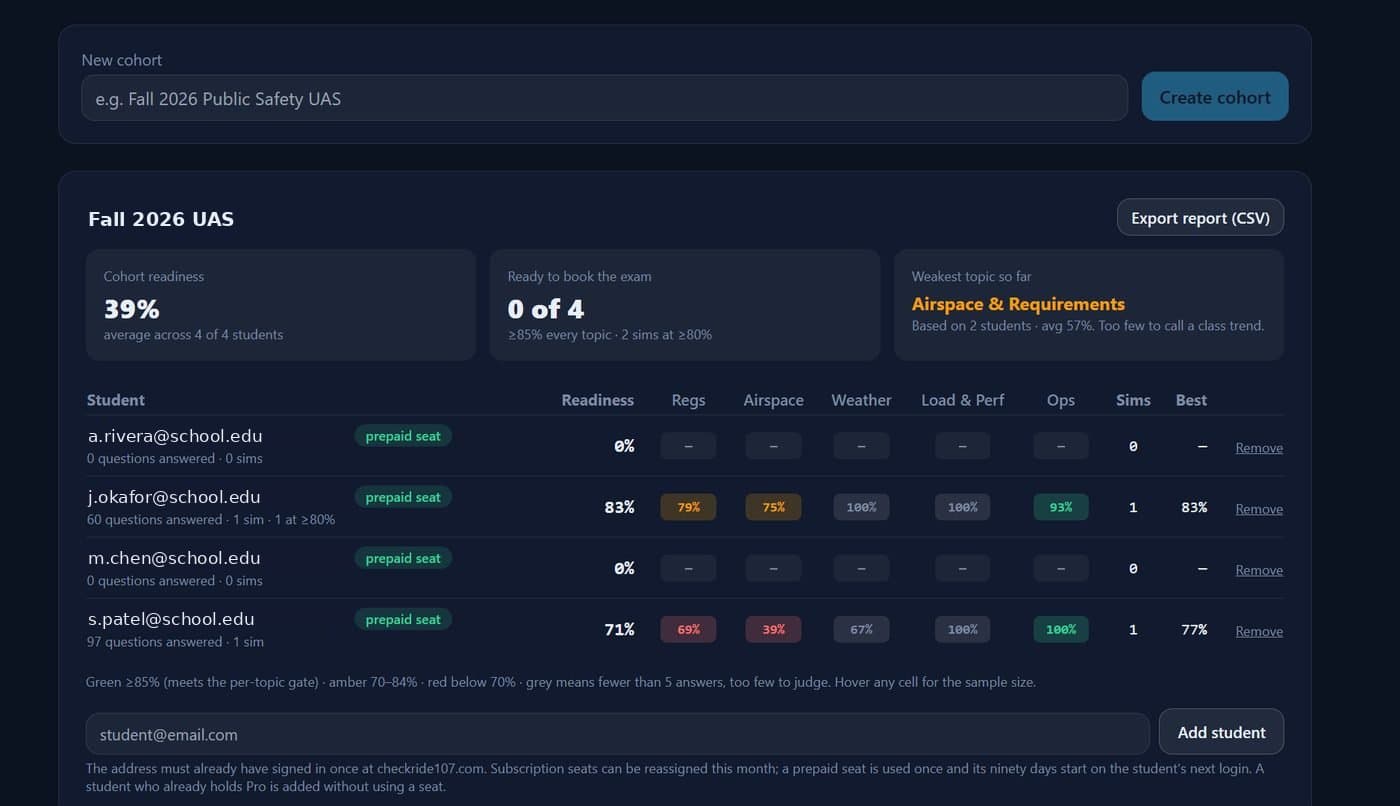
The instructor view. Student names shown are placeholders; every cell carries its sample size on hover.
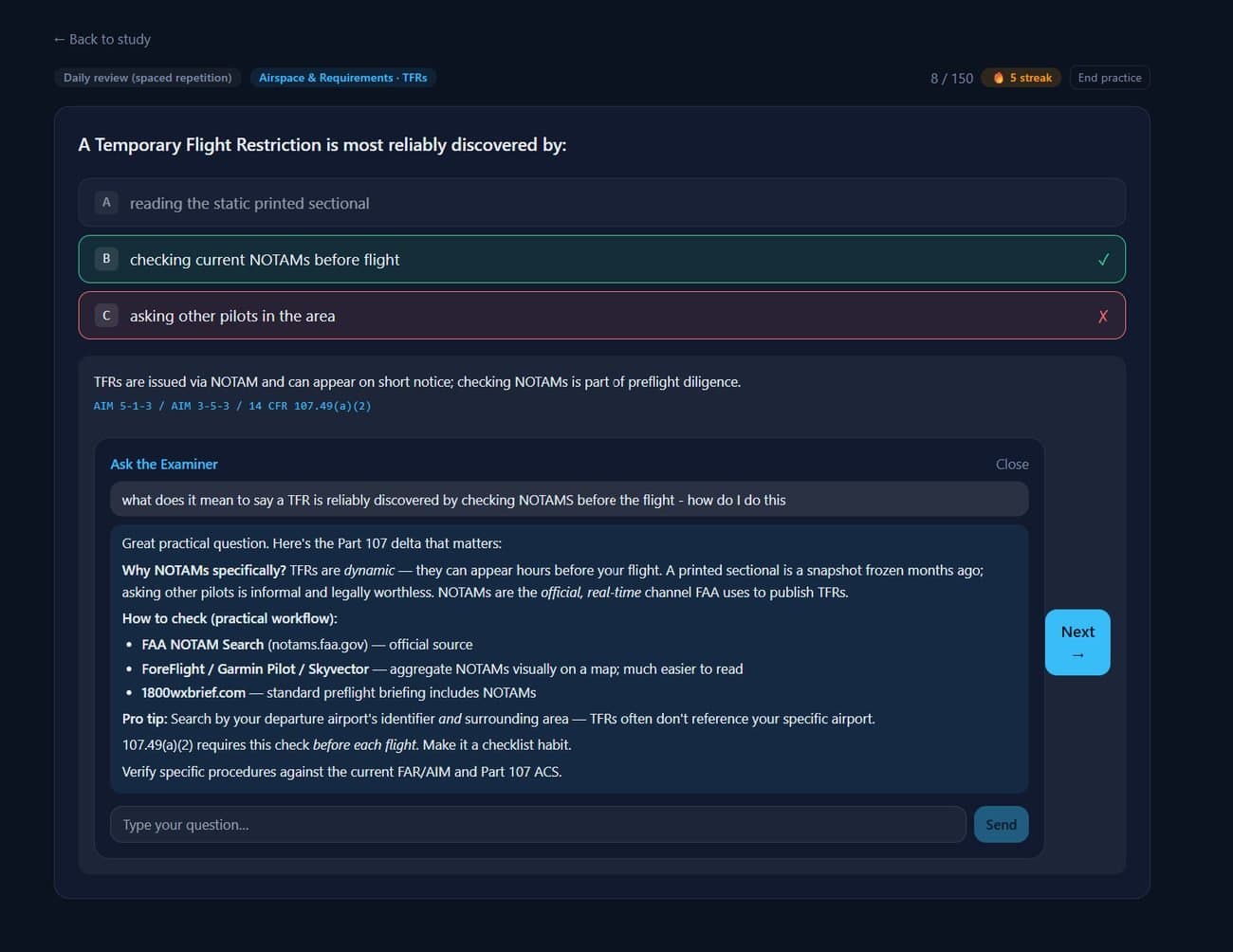
Students also get section drills — a student weak in one area drills that area rather than re-reading a whole course — and an AI tutor constrained to the cited source, which explains a verified answer and cannot write or change one. Every answered question becomes a card in a five-box spaced-repetition deck, so what a student misses comes back sooner than what they know. The method is explained on the student’s own Study page, under “How study works here”, in plain language.
The gate for “ready to book” is 85% on every topic plus two timed sims at 80% or better. A topic with fewer than five answers is greyed rather than scored — too thin to judge. It is stated so you can check it.
One platform, in class or online
Everything a student uses sits in one account. Run it as the practice layer under a classroom course, as the whole of an online one, or as the self-paced track between sessions. Nothing here needs a second product.
Timed sims in the real format
60 scored questions against the 120-minute clock, drawn to the current blueprint, 5 in a row with no repeated question.
Study drills by topic
Every question in a topic, in a fresh order each run, with the correct answer, a short explanation and the FAA citation after each answer.
Daily review on five boxes
Every answered question becomes a card. A missed card returns the same day; a card answered right on separate occasions climbs until it returns every 14 days. The student sees the method explained on their own Study page, and it is written up in How study works here.
Ask the Examiner
An AI tutor on every question, constrained to the cited source. It explains a verified answer and cannot write or change one.
Glossary and decoders
Part 107 terms grounded in FAA source material, and step-by-step decoders for the conversions that are procedures rather than facts: charted ceiling to height above ground, the structure envelope, cloud base, pattern side.
Readiness, the gate, and the guarantee
Readiness per topic with the sample size shown. The gate is 85% on every topic plus two timed sims at 80% or better. A topic with fewer than five answers is greyed rather than scored — too thin to judge. A money-back pass guarantee backs Pro and prepaid seats alike; the terms are below.
The FAA resource library, the exam guide, the Rule Tracker, the glossary and the decoders are free and need no seat, so a class can use them before a single seat is assigned.
The loop
A student drills Regulations. Their topic score moves. Their overall readiness moves. The class reteach-first priority re-orders.
Nobody typed anything.

Seats
Ten seats is not ten students.
A seat is occupied while a student is preparing and is reassigned when they finish. Ten seats serve ten students at a time, and as many students across a year as you run cohorts.
$250 per month · 10 student seats · $25 per seat
Buy, add seats and cancel from inside the product — nothing routed through us. Each seated student gets everything Pro includes for as long as the licence runs.
Students who have not been seated keep the free FAA resource library, the decoders, the glossary, the exam guide and the Rule Tracker, plus a 10-question sample test. Individually, Pro access runs 90 days.
How a program runs it
A one-week boot camp, a four-Saturday course, or a self-paced track a student starts before the first class. Checkride107 sits under the format you already run and the registration platform you already have.
One login per student
Every student has their own account, and there is no class login. Add students one at a time or upload your class list. Each student gets their seat the first time they sign in. Their drills, sims and readiness follow them from the lab machine to their own laptop to their phone.
Access through your own registration
With prepaid seats, each seat is a single-use code. Send it in the same email that confirms the class; the student’s 90 days start when they activate it. With a monthly block, you assign by email and reassign as classes turn over.
In the room or out of it
Any browser. Project a drill and lead the room through it with the citation on screen after each answer, or let students work self-paced with the daily review bringing back what they missed. The five FAA areas give the class its order.
What is not there, stated first
- A written syllabus. The five areas give the order; we build a boot-camp or four-Saturday outline with your instructor rather than hand you one that guesses at your hours.
- A list of other schools. We name no program that has not agreed to be named.
- A pass rate. We publish none, ours or anyone’s.
The first step is a screen-share with the person who runs the program and the instructor who will use it: the instructor view, then the free test drive set up on the same call, a few seats for fourteen days, once per program, so the instructor judges it against real students. The longer version is in How a flight school runs Checkride107.
The guarantee, for seats
Pro carries a money-back pass guarantee: reach the readiness gate, sit the official exam, fail, and the Pro fee is refunded on verified proof. Prepaid seats carry the same guarantee, and subscription seats work differently by design.
Prepaid seats Reseller Package · prepaid, one student each
A prepaid seat carries the Pro pass guarantee. When a student reached the readiness gate under that seat, sat the official exam afterwards, did not pass, and the claim meets every Pro condition, the unit price paid for that seat is refunded to the original purchase. One refund for each seat, ever. The seat stays used by that student.
The claim comes from the purchaser of the seat, within 30 days of the student’s exam date, with the student’s failing AKTR and their consent to share it. Each claim is reviewed and approved by hand.
Subscription seats Instructor Package · per month · 10 student seats · $25 per seat
A subscription seat is reassigned when a student finishes, so it serves the next student and the next class. The per-student guarantee belongs to prepaid seats, which are used once.
The conditions, in full, are on the guarantee page and in the terms. Passing our practice material does not guarantee passing the official exam, and we make no claim that the gate predicts it.
What comes out at the end
A per-student, per-topic record with a score, a sample size, and the sources behind them — something you hand to a dean, a grant officer or a chief without reformatting it. Every missed question carries its FAA citation, so the reteach starts from the source, not from our explanation.

What leaves the browser: Only the summary leaves the student’s browser — per-topic score, sample size, gate status. No answers, no question ids, nothing that reveals which items a student saw.
See it against your own course
Fifteen to twenty minutes, walking through the instructor view with your cohort in mind. We set up seats after that conversation, not before it.