Study method
How study works here: drills, daily review and the five boxes
September 23, 2026 · 4-minute read · Lindsay Hiebert
This is the plain-language version of the explainer that sits on every student’s Study page. It exists because the method matters more than the size of any bank, and because an instructor deciding whether to assign the tool should be able to read what a student will experience before a student does.
In one paragraph
You answer questions. Every question you answer becomes a card in your own deck. The deck keeps track of what you know and what you do not, and it brings back the questions you miss more often than the ones you get right. Over a couple of weeks the deck sorts itself, and the questions you struggle with get most of your attention without you managing anything.
Two ways to study
Drill by topic. Pick a topic, such as Weather. The drill shows you every question in that topic, one at a time, in a fresh random order each run. You pick an answer. Right away you see whether you were right, the correct answer, a short explanation, and the FAA source it comes from. You can ask the Examiner about that question before moving on, and you can stop at any point and see how you did. This is how cards get into your deck.
Daily review. This is the deck coming back to you. It shows only the cards due today, weakest first. Same experience per question: answer, see the result, read the explanation and the citation, move on. This is how cards get learned.
The five boxes
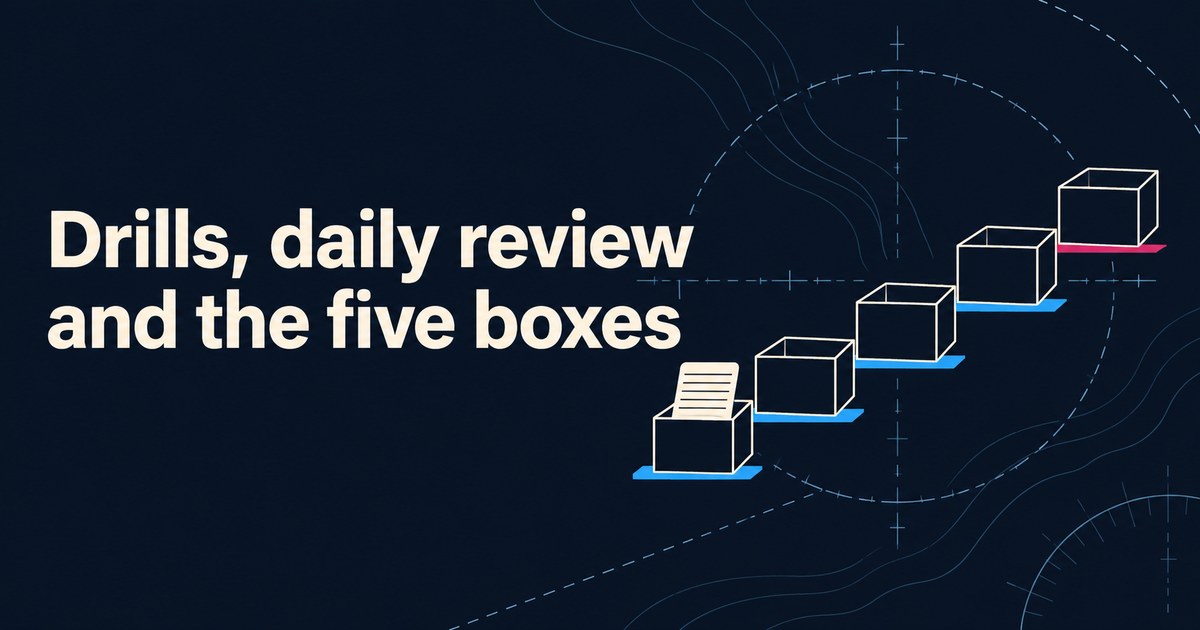
Think of five boxes on a shelf. Every card lives in one box.
- A card starts in Box 1 the first time you answer it.
- Answer it right and it moves up one box.
- Answer it wrong and it drops straight back to Box 1, whichever box it was in.
Each box waits longer before the card comes back.
| Box | Comes back |
|---|---|
| 1 | today |
| 2 | in one day |
| 3 | in three days |
| 4 | in seven days |
| 5 | in fourteen days |
So a card you keep getting right drifts up the shelf and you see it less and less. A card you keep missing stays near Box 1 and you see it almost every day. To get a card to Box 5 you have to answer it right on five separate occasions spread over about three weeks, which is the point. Getting it right once does not prove you know it.
 The loop: a drill puts cards in the first box, right answers move them up, and a missed card comes straight back.
This is the Leitner system, and it is old. We did not invent it. We did decide that it is the right loop for an exam that is mostly recall of regulations and procedures, and we built the rest of the product around it instead of around a bigger bank.
What a student experiences
Day one, you run a drill or two and answer a lot of questions. Your deck fills up and most cards are in Box 1.
Day two, the Review button shows a number. That is the cards due today. You work through them. Right answers move up, wrong answers stay.
Each day after that the review gets shorter and more focused, because the material you know has moved into the slow boxes and the review is mostly the material you do not. The Readiness page shows the same picture by topic, with the sample size beside each score, so you can see which topic to drill next. The Study page pre-selects your weakest one.
Why this works better than re-reading
Re-reading feels like learning and mostly is not. What makes a fact stick is trying to recall it, getting feedback, and being asked again just before you would have forgotten. The boxes schedule that automatically. Your time goes to what you do not know yet, not evenly across everything. And because every answer carries its FAA citation, you are learning the source, not the question.
One honest limit
The boxes build recall of these questions. The timed sims are where you find out whether that recall holds up in the real format, under the clock, with no feedback until the end. Drill and review to build the knowledge. Sim to test it. The readiness gate asks for both, and we make no claim that passing the gate predicts passing the exam, because no one has that data.
What to ask any tool about its study loop
If you are choosing a tool, for yourself or for a class, this is the question the method raises: when a student misses a question, what does the tool do with that? A bank that shows every question equally often spends the student’s time evenly across what they know and what they do not. A tool that says “adaptive” should be able to say what the schedule is, in days. If it cannot, it is a bank with a shuffle button. That question now sits alongside the twelve in the Training Tool Standard.
Canonical: https://checkride107.com/blog/how-study-works-drills-review-and-the-five-boxes. Not affiliated with or endorsed by the FAA; verify against the current FAR/AIM. All field notes →